

An Ode to Bro-etry
I played a version of this game. Here is how we end it.


This ode did not happen by accident.
It showed up in a conversation with my friend, Shelley Paxton .
Then in another with Carolina Migliaccio .
And, just yesterday, in this note from Tamara .
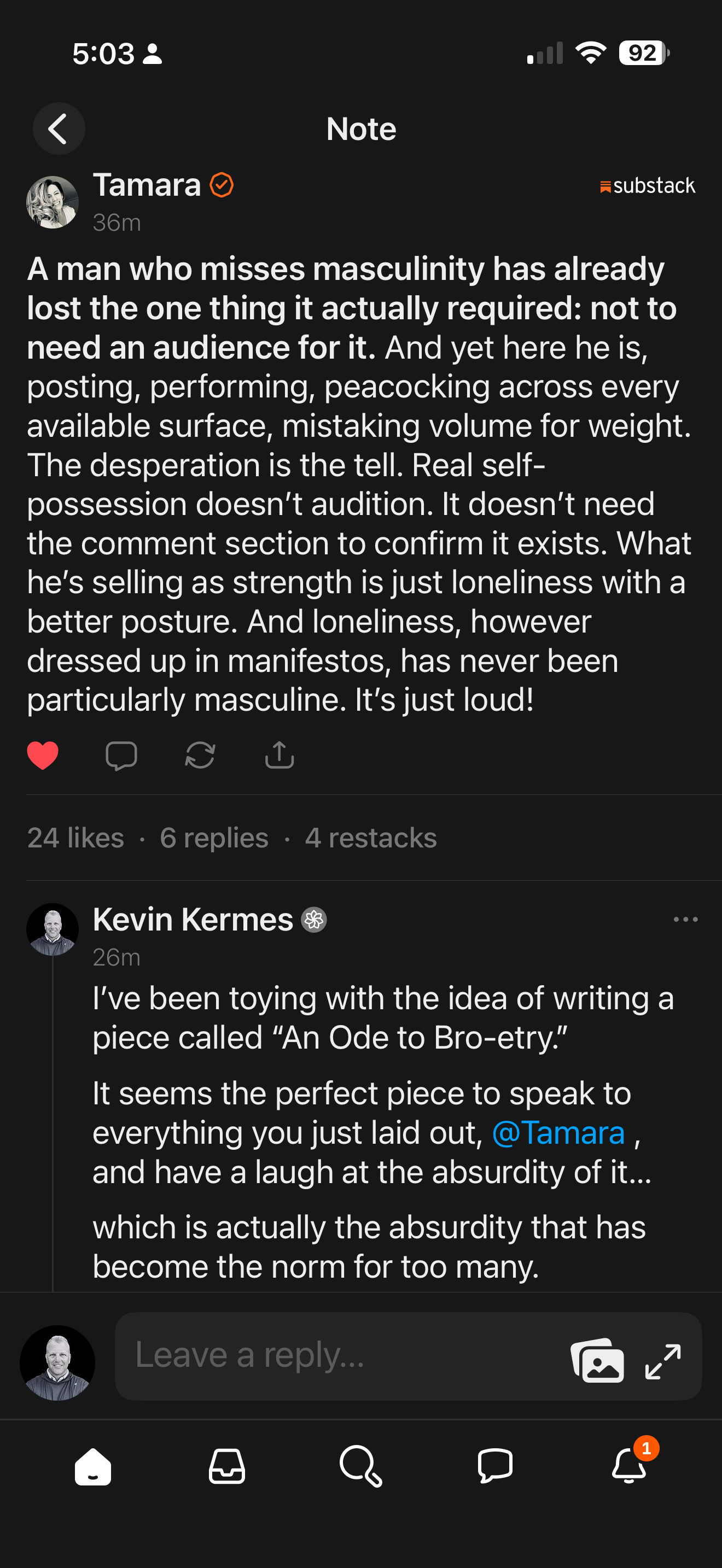
When the muse speaks, we listen.
And, with that, I give you…
An Ode to Bro-etry
Bro-etry works.
This is the hardest thing to admit.
It stops the thumb.
It sells the dream.
It mints the guru.
It pays the rent.
You have seen the shape.
One line.
Then another.
A punch.
A pause.
A close.
Often a lesson.
Usually a hustle story.
Always the word “grind.”
Every sentence fights for the next.
No clause hides.
No idea earns a paragraph.
The format strips argument to bone.
Call the work what the work is.
A masterwork of attention capture.
The algorithm rewards the format.
The writer feeds the format.
The reader trains on the format.
Engagement flows. Notifications ping. A small economy hums.
Now the confession.
I have played my version of this.
I have written posts I would not read.
I have adopted what did not fit.
I have measured a sentence by engagement, not truth.
I have served a success someone else defined.
The feeling matched corporate.
Selling a piece of me for the revenue.
I did not like the feeling then.
I don’t like the feeling now.
A job does not have to be perfect.
A platform does not have to be pure.
You do have to watch what you trade for the money.
Most of us in our fifties do not fit this costume.
We left one kind of b.s.
We walked into another.
Short lines. Big claims. Questionable advice dressed as wisdom.
And we, the readers, nod along.
We double-tap.
We comment “This.”
We share.
We quote post.
We feed the format.
The format feeds on us.
Look at what the format does to the writer.
The format rewards the boldest claim.
The format punishes the careful one.
The format demands a story of hustle whether the hustle happened or not.
The format flattens twenty years of hard-won experience into a three-line anecdote.
The nuance loses.
The grift wins.
Look at what the format does to the reader.
The format trains you to agree before you think.
The format trains you to double-tap what feels familiar.
The format trains you to mistake rhythm for insight.
The format trains you to confuse confidence with competence.
Here is the part being left out.
The format is not the enemy of thought.
We are.
The writer writes what we reward.
The reader rewards what the writer writes.
The loop closes.
Nobody reads anymore.
Everybody nods.
Here is the call.
No likes.
No comments.
No shares.
No quote posts pretending to push back.
Pushback is engagement.
Engagement is fuel.
Starve the format.
Scroll past.
Close the app.
Read a paragraph someone took a week to write.
Read a sentence with nothing to sell.
Read something ending without a link.
Without our attention, the format ends.
Not because we fought the format.
Because we stopped feeding the format.
Most of us in our fifties are tired.
Tired of performing.
Tired of optimizing.
Tired of selling a smaller version of ourselves for a bigger version of something we don’t truly desire.
The answer is not louder noise or better bro-etry.
The answer is quieter rooms.
Quieter rooms where the sentence matters.
Where the reader does the work.
Where the writer has room to be wrong.
Where nothing is going viral.
Where we mean what we say.
I’m Kevin and I’ve supported more than 17,000 senior professionals through career transformations since 2008. I write here for “The Quietly Ambitious” who are creating what’s next beyond corporate.
If this resonated, please share it with someone who needs to hear it.
There’s a word for what you describe that predates LinkedIn by two millennia: “epideictic rhetoric”, the ancient art of speech designed not to persuade or deliberate, but purely to perform shared values before an audience already converted. Aristotle considered it the least demanding of the three modes. The crowd already agrees. The orator doesn’t argue; he confirms. Bro-etry is epideictic at industrial scale. One line. Then another. Thought doesn’t necessarily run thin, but the form signals belonging, not thinking.
The double-tap is recognition, a tribal handshake, which is why your prescription (scroll past, close the app) may be necessary but isn’t sufficient. The format doesn’t live in the app. It migrates. It colonises how we speak in meetings, how we write emails, how we pitch ideas… short claims, bold nouns, no subordinate clauses where a subordinate clause might complicate things. The real contamination is cognitive, not digital.
The quieter room you call for could be a feed with better content, but I think it is a room where difficulty is permitted, where the sentence that needs a second read is allowed to exist, and where “I’m not sure” can survive without becoming its own kind of performance.
You wrote the diagnosis and the cure in the same breath, said the unsayable without performing the saying, and most critics of the format reproduce it in the act of critiquing it. You didn’t, Kevin! Bravo!
I feel this at a soul level, brother. Thank you for saying it out loud. 🙏🏼🧡