

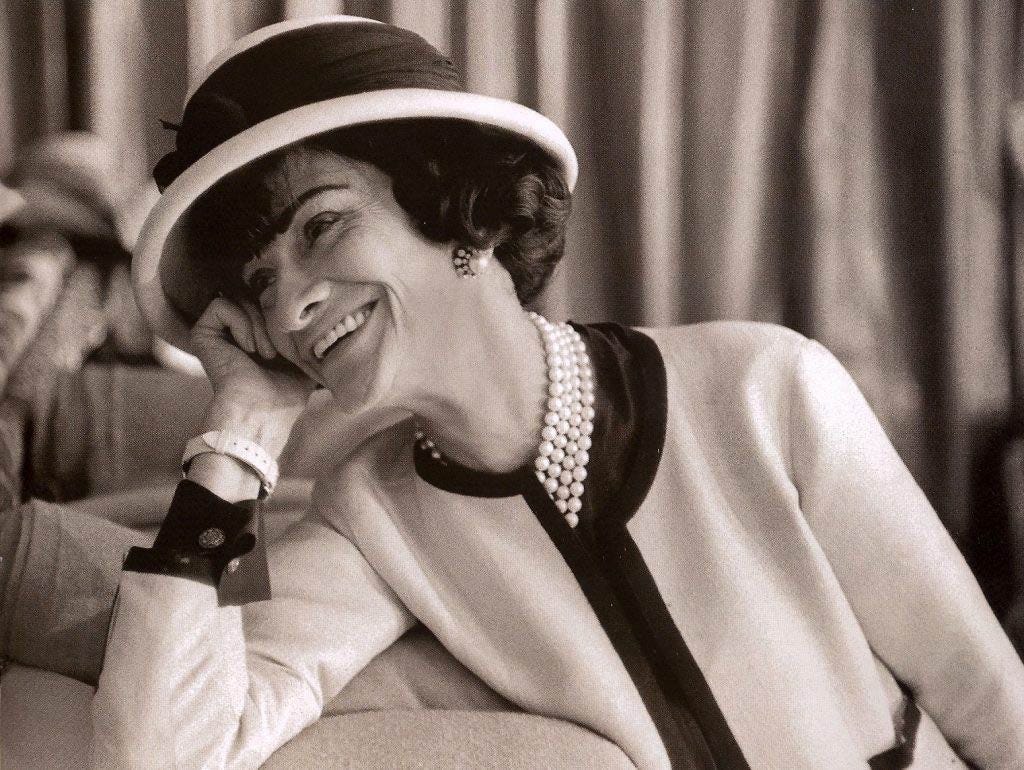
"Simplicity is the keynote of all true elegance."
With this declaration, Coco Chanel articulated not just a design philosophy, but a business strategy that would revolutionize fashion and create one of the world's most enduring brands.
While her competitors were adding frills, complications, and ornamentations to women's clothing, Chanel was doing something radical: she was taking things away.
Where others saw luxury in excess, she saw it in reduction.
Where others built complexity, she built classics.
Where others chased trends, she created timeless principles that would outlast every fashion cycle.
"I don't do fashion. I am fashion," Chanel famously said.
But what she really was, was an architect.
Chanel designed not just clothes, but an entirely new way of thinking about elegance, business, and what it means to build something that lasts.
The Moment of Choice
Chanel's revolutionary choice came not in a single moment, but in a series of decisions that revealed her understanding of something profound: true luxury is the opposite of vulgarity, not the opposite of poverty.
Born Gabrielle Bonheur Chanel in 1883, she grew up in humble beginnings. Raised in an orphanage after her mother's death, she gleaned her first lessons in simplicity and practicality. These early experiences forged her spirit of independence and a penchant for challenging conventions.
When she entered the fashion world, the industry was dominated by restrictive corsets, elaborate petticoats, and clothing that prioritized appearance over functionality. Women's fashion was about display, not livability.
Chanel looked at this system and made a choice that would define her career: she would liberate women through simplicity.
"I wanted to give a woman comfortable clothes that would flow with her body. A woman is closest to being naked when she is well-dressed."
This wasn't just about comfort.
It was about redefining what luxury meant.
Her early breakthrough came with her use of jersey fabric, traditionally used for men's underwear.
She was the first to use cotton jersey in womenswear. This revolutionised the oppressive fashion of the 19th century, liberating women from restrictive corsets and fussy petticoats with her elegant, more casual designs which were, primarily, comfortable to wear.
The Contrarian Path
While her competitors were building their brands on exclusivity through complexity, Chanel built hers on exclusivity through essential perfection.
Her approach had three revolutionary elements:
Subtraction over addition: "Before you leave the house, look in the mirror and take one thing off." Where others added embellishments, Chanel removed them. Her designs worked by elimination—every element had to justify its existence.
Function as luxury: "Luxury must be comfortable, otherwise it is not luxury." She redefined luxury as something that enhanced life rather than constrained it. This was revolutionary in an era when luxury fashion often made women less functional, not more.
Timeless over trendy: "Fashion changes, but style endures." Rather than chasing each season's trends, Chanel created pieces that would work for decades. The little black dress, the Chanel suit, the quilted handbag—these weren't fashion statements, they were wardrobe foundations.
Her approach extended beyond individual pieces to her entire business philosophy. "Innovation! One cannot be forever innovating. I want to create classics." This wasn't about lack of creativity—it was about understanding that true innovation creates things that last, not things that need constant replacement.
Black as liberation: "I imposed black; it's still going strong today, for black wipes out everything else around." By championing black as the ultimate elegant color, she gave women a choice that was both sophisticated and practical. Black didn't go out of style, didn't show wear, and worked in any situation.
The System's Response
The fashion establishment's response to Chanel was complex and often contradictory. They recognized her talent while questioning her methods.
Traditional fashion houses relied on constant innovation, seasonal changes, and the pressure to continuously buy new pieces. Chanel's philosophy of timeless classics threatened this entire business model. If women could buy a Chanel suit and wear it for decades, what happened to the fashion cycle?
Her relationship with men in the industry was particularly complicated.
Many couldn't understand how someone could build a luxury brand on simplicity.
"Some people think luxury is the opposite of poverty. It is not. It is the opposite of vulgarity," she insisted, but this distinction was lost on many in the industry.
The broader cultural establishment also struggled with Chanel's message. Her designs suggested that women should be comfortable, functional, and elegant. Revolutionary ideas in a society that preferred women to be decorative.
World War II created the most significant challenge to her empire.
Chanel's controversial relationship with a German officer during the Nazi occupation led to her temporary exile from fashion.
The industry used this opportunity to move past her influence, embracing the "New Look" of Christian Dior with its emphasis on curves, corseting, and traditional femininity.
For more than a decade, it seemed that fashion had rejected Chanel's philosophy of simplicity and comfort in favor of a return to elaborate, restrictive designs.
The Quiet Victory
Chanel's comeback in 1954, at age 71, would prove the enduring power of her approach. While her initial return was met with skepticism from the French press, American buyers immediately understood the value of her timeless designs.
The Chanel suit became the uniform of the modern professional woman. The quilted handbag became a status symbol that transcended fashion cycles. The little black dress remained a wardrobe essential.
But her real victory was philosophical: she had proven that simplicity could be more luxurious than complexity, that reduction could be more powerful than addition.
Time magazine came out with its "100 Persons of the Century," she was the sole fashion figure to make the list.
She was a pioneering designer who simplified silhouettes down to their bare minimum, freeing women from corsetry and infusing menswear sensibilities into her patterns and fabric selections.
Her business model proved equally enduring.
The Chanel brand has survived and thrived for over a century precisely because it was built on timeless principles rather than trend-driven changes.
Today, the brand remains one of the most prestigious and influential names in the fashion industry.
The influence extended far beyond fashion. Her approach to building a brand around consistent principles, her understanding of the power of signature elements, and her focus on quality over quantity became templates for luxury businesses across industries.
The Modern Lesson
Chanel's approach offers profound insights for quietly ambitious leaders building sustainable enterprises:
Architecture over decoration: "Simplicity is the keynote of all true elegance." In business as in fashion, the most sustainable approaches focus on essential structure rather than superficial appeal.
Ask: "What would this look like if I removed everything unnecessary?"
Classics over campaigns: "I want to create classics." Rather than constantly launching new initiatives, Chanel perfected a few key offerings and made them excellent.
Modern leaders can ask: "What are the few things I want to be known for, and how can I make them impossibly good?"
Function as luxury: "Luxury must be comfortable, otherwise it is not luxury." The highest-value products and services make clients' lives better, not more complicated.
True luxury enhances capability rather than constraining it.
Personal uniform over constant change: "Fashion fades, only style remains the same." Chanel's personal aesthetic was remarkably consistent—bobbed hair, red lips, simple black clothes. This consistency became part of her brand power.
Leaders can ask: "What's my consistent approach that people can rely on?"
Timeless principles over trendy tactics: "A fashion that does not reach the streets is not a fashion." Chanel understood that sustainable success comes from creating things that work in real life, not just in ideal conditions.
Strategic constraints: "Before you leave the house, look in the mirror and take one thing off."
Constraints create clarity. By limiting color palettes, design elements, and business focus, you can create more impact with less effort.
Quality as differentiation: "A woman can be overdressed but never over elegant." In markets flooded with cheap alternatives, exceptional quality becomes the ultimate differentiator.
Philosophy over product: "I don't care what you think about me. I don't think about you at all." Chanel built her brand around consistent philosophical principles rather than market research or customer feedback.
This gave her work a coherence that market-driven approaches often lack.
The conventional approach to building a fashion empire involves constantly creating new designs, following trends, and adapting to market demands. Chanel chose the opposite approach: she created a few perfect things and then refined them endlessly.
"To be irreplaceable, one must always be different." But Chanel's version of being different wasn't about constant change. It was about being so consistently herself that no one else could replicate her approach.
Her approach required tremendous discipline. It would have been easier to follow trends, to add embellishments that customers wanted, to create seasonal collections that drove frequent purchases. Instead, she held to her vision of what luxury should be, even when it cost her short-term sales.
"Success is often achieved by those who don't know that failure is inevitable." Chanel's confidence in her approach was absolute, which allowed her to persist through periods when the market moved away from her aesthetic.
For quietly ambitious leaders, Chanel's example poses fundamental questions:
What would your business look like if you focused on perfecting a few essential offerings rather than constantly adding new ones?
How would your approach change if you optimized for timelessness rather than timeliness?
Chanel proved that the most sustainable competitive advantage comes not from doing more things, but from doing essential things so well that they become irreplaceable.
"I am my own experiment. I am my own work of art." In the end, Chanel's greatest creation wasn't any single design. It was a way of thinking about elegance, business, and life that continues to influence how we build things that last.
Want more stories of leaders who built empires through strategic simplicity? Subscribe to The Quietly Ambitious…where less becomes more.


Kevin, Great example and illustration of simplicity in business. Reading this caused me to consider other industries (e.g. automobile vs medical). I wrote a thesis paper in 1999 suggesting that the Army, to remain competitive, must move away from developing mostly generalists in warfare and expand Soldiers in specialized career fields.
I love this! Subtle and simplistic elegance - I’ve never known this about Chanel but I love it even more. She is correct, luxury is comfort and subtle beauty, which calls into question most fashion today where models can’t last longer than 2 seconds in heels or sit in a dress that’s too tight or too small.