

More Work for Mother
The real threat of "more" for middle-age Creators building a life-first business

I opened my email this morning and felt the weight settle into my shoulders.
Forty-seven unread newsletters. AI tools that promise to change everything. Prompts that will “10x your output.” Growth hacks. Automation secrets. The future of content creation, delivered daily to my inbox.
I’ve been collecting these for months. Filing them into folders I’ll never open. Convincing myself I’m staying current when really I’m just hoarding information I’ll never use.
Here’s what I know: none of it is important. If there are stacks and stacks of articles to review, then none of them matter. The volume itself is the tell.
And I’m not creating anything with any of it.
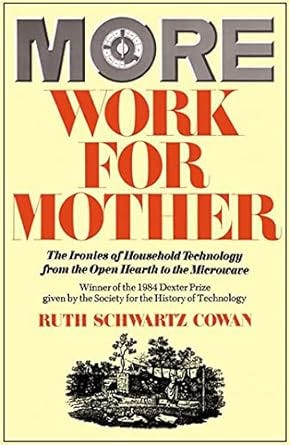
In 1983, a historian named Ruth Schwartz Cowan wrote a book called More Work for Mother. The subtitle tells you everything: “The Ironies of Household Technology from the Open Hearth to the Microwave.”
Her argument was simple and devastating.
All those appliances that were supposed to liberate women, the washing machines and vacuum cleaners and electric stoves, they didn’t reduce the work. They raised the standard.
Before the washing machine, clothes got washed once a week. Maybe less. After the washing machine, clothes were expected to be washed after every wear. The tool didn’t free anyone. It just made more work possible. And once more was possible, more became expected.
The vacuum cleaner didn’t give women their afternoons back. It redefined what “clean” meant. Now the floors needed to be spotless. Now visible dust was a moral failing.
Cowan’s central question cuts through everything: whose labor does the technology actually save? And whose workload does it quietly increase?
I think about this every time I see another AI tool promising to help me “write 7 articles a week instead of one.”
That’s not freedom. That’s a vacuum cleaner with a not-so-subtle expectation attached.
The implicit message underneath all of it: you should be producing more. If you’re only writing one piece a week, you’re falling behind. The people who win are the ones who publish daily. Volume is the game now. AI makes it possible, so AI makes it mandatory.
I feel this in my chest when I scroll LinkedIn. Everyone cranking out content. Most of it sounds the same. The platforms reward consistency over craft, frequency over depth. And the tools keep getting better at helping us produce more of what nobody asked for.

Here’s what I’ve noticed about the voices shouting loudest about productivity and output: most of them are in their 20s and 30s.
That’s fine. That’s the season they’re in. You’re supposed to run hard in your 20s. You’re supposed to test everything in your 30s.
But I’m not in that season anymore.
I don’t want to work less. I want to work differently. High impact for a handful of hours. Then the rest spent getting better at my craft. That’s a different game entirely.
And most of the advice out there isn’t built for that game.
The artist doesn’t think about output.
Rick Rubin talks about this in The Creative Act. Stop worrying about what the audience wants. Stop optimizing for the algorithm. Create the thing that needs to exist, and trust that the right people will find it.
One phenomenal piece beats seven forgettable ones. Every time.
The technology should serve that, not work against it. AI can help me refine a single idea until it’s undeniable. It can help me find the precise word, sharpen the argument, cut the fat. That’s a tool worth using.
But AI that helps me churn out more stuff faster? That’s just a vacuum cleaner with better marketing.

So here’s where I’ve landed.
I’m done collecting. I’m unsubscribing from the noise. If I haven’t read it in two months, I’m not going to read it. Delete.
I’m done with the expectation that more is better. It isn’t. More is just more. And more of what nobody needs is still nothing.
I’m creating something different. A body of work that actually matters. Something that names a real problem, sits with the weight of it, and offers something you can actually use.
Not content. Impact.

If you’re in your 50s or beyond and you’re building something next, you already know the game has changed for you.
The hustle advice doesn’t fit anymore. The “crush it” mentality feels exhausting. You’ve done enough crushing. Now you want to create something that lasts.
That’s the work I’m interested in.
Not more. Better.
The vacuum cleaner promised freedom and delivered higher standards and expectations.
Let’s not make the same mistake twice.
What would change if you used these tools to create one undeniable thing instead of ten forgettable ones? I’d love to hear what that might look like for you.
Now moving into semi-retirement and focused on thought-leadership, helping others succeed, and taking the time to reflect, your observations are spot on. The technology (AI) can help refine the message, the tone, but the creation of more content does in fact create more noise and less listening. I've recently pared down the subscription-based content (yours is on my list) for the purposes of cutting down to those who have relevant messaging with an appropriate cadence. As an observer, I'm looking forward to seeing where the technology takes us. At the time the cell phone came out (think plug-in bag phone) were we considering where else it would take us? The internet at our finger-tips and instant communication? No, we were happy just to not put a dime in the pay phone. Today, we have the opportunity to lean in and embrace the best of what the technology brings or have it run over us. I choose the former rather than the latter.
What a brilliant insight! Technology shifts standards. A bit like Jevon's Paradox. Thanks for writing this!